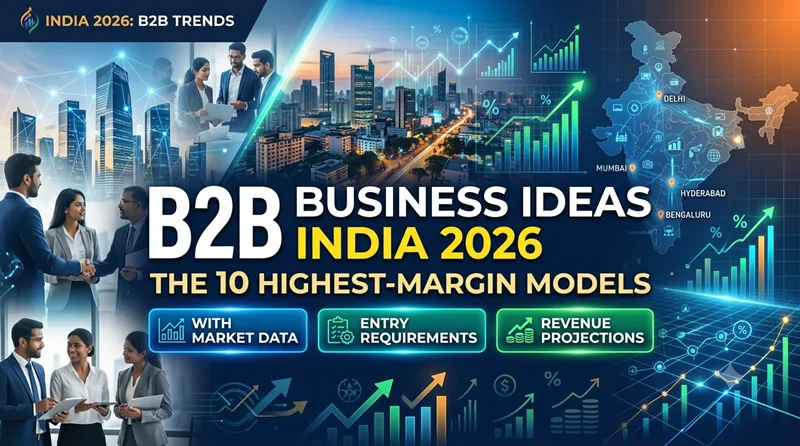
B2B business ideas India 2026 represent the most underexplored commercial opportunity available to Indian professionals, domain experts, and entrepreneurs with industry knowledge and professional networks. While most business conversation in India focuses on direct-to-consumer models — D2C brands, food businesses, retail, and consumer apps — the business-to-business segment is where the highest margins, the most predictable revenue, the most defensible competitive positions, and the most scalable growth trajectories consistently exist.
The economics that make B2B superior to B2C for most founders: businesses are more rational buyers than consumers, make purchasing decisions based on measurable ROI rather than emotional impulse, and generate recurring revenue through contracts and subscriptions that B2C rarely achieves at comparable margins. A single B2B contract worth Rs. 3 lakh per year represents more predictable value than 150 B2C transactions of Rs. 2,000 each — because the contract has a defined tenure, requires one relationship to maintain, and is not subject to the daily marketing spend required to attract new consumer purchases.
This guide presents ten B2B business models that are specifically validated for India’s 2026 market — with market size data, entry investment requirements, margin structures, and the professional background that each model demands.
Model 1: B2B SaaS for Specific Indian Industry Niches
Market context: India’s SaaS industry is projected to reach a $100 billion market by 2030, growing at approximately 25–30% annually. The highest-opportunity segment is not horizontal enterprise software competing with global players — it is vertical SaaS solving problems specific to Indian industry niches that global software ignores.
The opportunity: India has thousands of industry verticals with unique regulatory, linguistic, and operational requirements that global software platforms do not address: government contract management for MSMEs, vernacular GST filing for small traders, agricultural input supply chain management for FPOs (Farmer Producer Organisations), clinic management for Ayurvedic practices, and compliance tracking for labour code obligations under India’s new Labour Codes — each of these is a vertical-specific SaaS opportunity with a large, underserved market.
Entry investment: Rs. 5–15 lakh (product development if hiring a co-founder or contractor, or lower if the founder is technical)
Revenue model: Monthly or annual subscription per business user (Rs. 500–5,000 per user per month depending on the complexity and value of the software)
Margin structure: 70–85% gross margin at scale, making SaaS the highest-margin business model available across all sectors
Professional background suited: Domain experts in healthcare, agriculture, manufacturing, legal, or finance who identify a workflow problem in their industry that existing software does not solve — and who can either build the solution or partner with a technical co-founder
The critical insight: The founders who build successful vertical SaaS companies in India are not primarily technical founders who code a solution and then look for a market. They are domain experts who understand a market’s specific workflow problem deeply enough that the software specification is obvious — and who then recruit or contract the technical talent required to build it.
Model 2: HR Technology and Recruitment Services for Mid-Market Companies
Market context: India’s HR technology market is growing at 20–25% annually, driven by the formalisation of MSME employment under the new Labour Codes, the adoption of digital HR workflows by companies that previously managed HR through spreadsheets, and the talent acquisition pressure that makes professional recruitment support valuable.
The opportunity: Mid-market Indian companies (50–500 employees) are too large to manage HR manually but too small to afford enterprise HRMS platforms. A B2B HR services provider offering a combination of digital HR infrastructure (payroll processing, attendance management, leave tracking, compliance monitoring) and occasional recruitment support occupies a market segment with minimal sophisticated competition and genuine pain.
Entry investment: Rs. 1–3 lakh (HRMS platform subscription resale or white-label arrangement, basic business infrastructure)
Revenue model: Monthly retainer per client company (Rs. 15,000–45,000 depending on employee count and services scope), per-hire recruitment fees (15–20% of first-year salary for placed candidates)
Margin structure: 55–70% gross margin after software and operations costs
The specific value proposition that India’s mid-market needs: A single professional or small team that handles PF, ESI, professional tax, TDS on salary, quarterly TDS returns, labour law compliance under the new codes, and occasional recruitment support — completely removing the HR compliance burden from the business owner who currently manages it personally with significant error and anxiety.
Model 3: Compliance and Regulatory Consulting for MSMEs
Market context: India’s 6.3 crore MSMEs collectively face an expanding compliance landscape in 2026: four new Labour Codes now in force, SEBI BRSR requirements filtering down to MSME supply chains, GST’s evolving audit and reconciliation requirements, and the DPIIT’s startup recognition compliance requirements. Most MSME owners neither have the knowledge to navigate this landscape nor the time to develop it.
The opportunity: A consulting practice that specialises in MSME compliance navigation — helping businesses achieve and maintain Udyam registration, DPIIT recognition, GST compliance, new Labour Code compliance, and sector-specific regulatory requirements — addresses a gap that growing numbers of MSME owners are willing to pay to fill.
Entry investment: Rs. 50,000–1.5 lakh (professional qualification costs if not already a CA/CS/CMA, basic digital infrastructure, marketing materials)
Revenue model: One-time compliance setup fees (Rs. 25,000–75,000 for initial registration and system setup), monthly compliance maintenance retainer (Rs. 5,000–15,000 per client), annual compliance audit fees (Rs. 15,000–40,000)
Margin structure: 65–80% gross margin — the primary cost is professional time
The market trend that makes this sustainable: Compliance complexity is increasing, not decreasing, in India. Every new regulatory framework creates a new category of compliance clients. A professional who builds genuine regulatory expertise will have an expanding market regardless of economic cycles.
Model 4: B2B Content and Thought Leadership Services
Market context: India’s B2B companies — technology companies, financial services firms, professional service practices, and industrial manufacturers — are increasingly competing for business through content and thought leadership as the primary trust-building mechanism with enterprise buyers. Yet most lack the internal writing, strategy, and production capacity to execute consistently.
The opportunity: A B2B content agency that produces technical white papers, industry research reports, case studies, LinkedIn thought leadership content, email newsletters, and website content for B2B companies addresses a genuinely high-value gap. The key differentiation from standard content agencies: deep domain understanding in the client’s specific B2B sector, not just generic writing skill.
Entry investment: Rs. 10,000–30,000 (digital infrastructure, basic design tools — Canva Pro, Adobe Express, or similar — and a portfolio built through two to three pro-bono engagements that demonstrate domain-specific content quality)
Revenue model: Monthly content retainer (Rs. 30,000–1,20,000 per client depending on volume and complexity), per-project research report fees (Rs. 50,000–2,00,000 for comprehensive industry white papers)
Margin structure: 70–85% gross margin — AI-assisted writing tools have dramatically reduced the time required for first-draft production while the strategy, domain expertise, and quality control layer remains exclusively human
The specialisation that commands premium rates: Writers who develop genuine competency in a specific B2B sector — fintech, healthcare technology, SaaS, industrial manufacturing, or legal services — command rates 3–5 times those of generalist B2B content providers.
Model 5: Cybersecurity Assessment and Managed Security Services for SMEs
Market context: India faces over 3,000 cybersecurity attacks per week, with small and medium enterprises (SMEs) increasingly the primary targets. NASSCOM reports a 60–73% demand-supply gap in cybersecurity talent. The SEBI BRSR framework’s cybersecurity disclosure requirements for large listed companies are creating supply chain security assessment obligations that flow down to their MSME vendors.
The opportunity: A cybersecurity consulting practice serving SMEs with security assessment, basic security implementation, and periodic monitoring needs addresses a market that is simultaneously growing rapidly and largely unserved by qualified professionals.
Entry investment: Rs. 1–3 lakh (certifications — CompTIA Security+, CEH, or CISSP; assessment tools; basic marketing)
Revenue model: Annual security assessment fees (Rs. 25,000–75,000 per SME), monthly managed security monitoring retainer (Rs. 8,000–20,000 per client), incident response fees (project-based, Rs. 50,000–3,00,000 depending on incident severity)
Margin structure: 60–75% gross margin after tool costs and time investment
Models 6–10: Quick Reference for Additional B2B Opportunities
Model 6: Corporate Training and L&D Services
Specialised corporate training in AI tools, digital marketing, finance literacy, or compliance for corporate clients. Rs. 50,000–2,00,000 per training engagement for groups of 20–50 employees. Entry investment: Rs. 30,000–80,000.
Model 7: Financial Modelling and Business Intelligence Services
Building financial models, business dashboards, and investor-ready documentation for startups, SMEs, and pre-IPO companies. Rs. 25,000–2,00,000 per project. Entry investment: Rs. 20,000–50,000. Background required: strong finance and Excel/Python analytical capability.
Model 8: Logistics and Supply Chain Optimisation Consulting
Helping manufacturing MSMEs reduce inventory costs, improve supplier relationships, and implement basic ERP tracking. Monthly retainer: Rs. 20,000–60,000 per client. Entry investment: Rs. 40,000–1,20,000.
Model 9: Video Production and Visual Content for B2B Companies
Corporate video production — product demos, training videos, investor presentations, thought leadership — for B2B technology and manufacturing companies. Rs. 30,000–2,00,000 per project. Entry investment: Rs. 2–5 lakh (camera equipment, editing software, lighting).
Model 10: Market Research and Competitive Intelligence
Primary and secondary market research for MSME manufacturers, technology companies, and investors entering new sectors. Rs. 50,000–3,00,000 per research engagement. Entry investment: Rs. 30,000–80,000.
The B2B Model Selection Framework: Choosing Your Highest-Opportunity Entry Point
The optimal B2B business model is the intersection of three variables: your existing domain expertise (built through previous employment or education), the specific pain a definable group of businesses currently experiences and pays to solve, and your ability to deliver the solution repeatedly at consistent quality.
The founders who build the most quickly profitable B2B businesses in India’s 2026 market are not those who identified a theoretically attractive opportunity and then built the capabilities to serve it. They are those who recognised that a problem they solve naturally — from their professional domain experience — was one that hundreds or thousands of businesses were willing to pay a professional to solve for them.
Your professional expertise is not just your qualification. It is the most valuable commercial asset you own. The B2B business that monetises that expertise through a focused, well-positioned services or software offering is the fastest path from professional employee to profitable founder.
ProEdgeHub.in covers B2B business strategy, entrepreneurship intelligence, startup guidance, and commercial opportunity analysis for India’s entrepreneurs and professionals. Follow us daily.
Discover more from Pro Edge Hub
Subscribe to get the latest posts sent to your email.